FAQs on NFT Credentials in Education: Everything You Need to Know
 Author:
Artem Grigoriev
Author:
Artem Grigoriev
 Reading time:
14 minutes
Reading time:
14 minutes
 Difficulty:
Beginner
Difficulty:
Beginner
 Rating:
5/5
Rating:
5/5
- What Exactly Is an NFT Credential?
- How Are These More Secure Than Traditional Diplomas?
- Who Owns and Controls My Digital Credentials?
- How Do I Share an NFT Credential With an Employer?
- What Are the Main Benefits for Students and Universities?
- Are NFT Credentials Accessible to All Students?
- What About the Environmental Concerns of NFTs?
- Summary: Decoding NFT Credentials for a More Secure and Portable Future
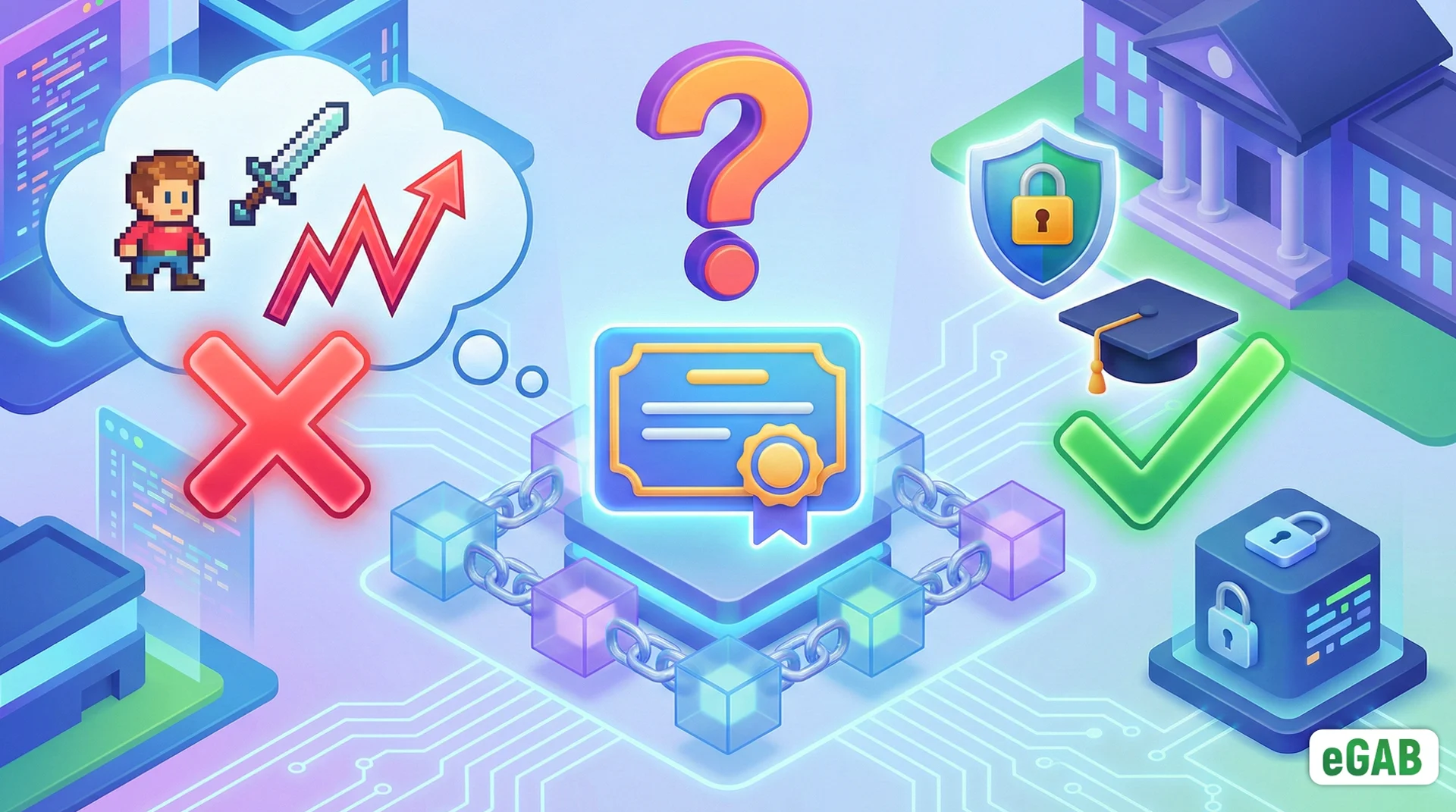
Let's be honest. When you hear "NFT," your mind probably jumps straight to digital art or collectibles. Or maybe you think of the ups and downs of the crypto market, right? It’s a world that can feel a million miles away. It seems so different from something as established and serious as your university degree.
This very confusion is often the biggest hurdle to overcome. So, what exactly is an NFT credential? Is it just a passing trend? Or is it a genuinely secure, next-generation standard for blockchain credentials for education? Here’s the most important thing to understand. A true NFT diploma or certificate has absolutely nothing to do with those public art markets.
Think of it instead as a powerful, secure "digital twin" . It's a digital copy of your academic achievement. It's issued on a private, controlled, and trusted system. This system was built from the ground up specifically for privacy and verification. You've clearly got questions, and you're not alone in that. This article is here to provide the answers you need. We're about to walk through everything you need to know. We'll tackle the biggest FAQs one by one. We'll cover how security and privacy actually work. We'll also look at who really owns your data and whether this technology is harming the environment.
📘 These answers provide the foundational clarity needed to navigate the comprehensive framework of the Complete Guide to Digital Documents.
What Exactly Is an NFT Credential?
You’ve probably heard about NFTs. And let's be honest, your mind likely goes straight to digital art or collectibles, right? It's a fair assumption! But in the world of education, an NFT credential isn't just a collectible. No, it's something much more: a serious, secure "digital twin" (a precise digital replica) of your academic achievement. This could be your degree, a special certification, or even a secure digital transcript of your courses. Think of it as the official, verifiable, digital version of your diploma or certificate. It's locked right on a blockchain. These NFT diplomas and certificates represent a massive leap forward from paper. In essence, these are blockchain credentials for education, truly a new standard for academic proof.
However, this is exactly where a critical distinction comes in. A true academic credential isn’t just any "NFT." It's not something simply dropped onto a public chain (an open network anyone can join) where people trade cartoons-can you imagine? That would be a security nightmare! This is precisely why it must be part of a secure, trusted program. We're talking about something robust, like the Global Digital Credentials Management Program . This program is offered by eGAB (Global Academic Blockchain Ecosystem). It's this kind of professional approach that ensures your credential is a verifiable, valuable asset. It's issued on a purpose-built (designed for one specific function), private blockchain, like the CREST Chain , and, importantly, it is not issued on a public marketplace.
Why It Matters: Here's a simple analogy to make this crystal clear. Think of the difference between a novelty ID you buy at a theme park. Now, compare that to a government-issued passport. One is just for fun and has no real-world authority. The other, in contrast, is a globally trusted document. eGAB provides the "passport" for your credentials .

How Are These More Secure Than Traditional Diplomas?
The magic word here is immutability. That’s just a fancy way of saying its history is permanent and unchangeable. This creates an immutable record that is truly forgery-proof , which is the foundation for the entire security of digital credentials . And how is this all possible? It's because the credential exists on a blockchain. This simple fact instantly makes traditional forgery and tampering practically impossible. But real security, as you'll see, is about more than just that.
Here's the problem: Putting sensitive student data on a blockchain that is public is a terrible idea. Frankly, it’s a privacy disaster, as it can expose sensitive personal information. This raises huge questions about the public vs private blockchain for education debate. So, what is the difference between a public and private blockchain for credentials? Well, a public chain is open, anonymous, and uncontrollable, which is a nightmare for Data privacy (GDPR, FERPA) compliance. This action could potentially violate stringent data privacy laws (very strict rules about data protection). Just think of the EU's GDPR (General Data Protection Regulation) or the U.S.'s FERPA (Family Educational Rights and Privacy Act). It also offers zero institutional control-it's the "wild west." This is exactly the problem that the eGAB ecosystem solves by using the CREST Chain. How? You can think of it as a proprietary (privately owned and controlled, not public), high-security vault built specifically for educational compliance (following all the required rules and laws). It’s a completely controlled environment where institutions, and not the public, manage their data. This control is often managed through smart contracts, which are self-executing agreements that handle the rules of issuance and verification securely within the private chain.
Takeaway: Public blockchains are built for anonymity and public access . Education, however, requires privacy and control . The CREST Chain is different. It's designed from the ground up to meet those very specific compliance and security needs.

Who Owns and Controls My Digital Credentials?
This is a truly crucial question. And the answer, as you'll see, is more nuanced than you might think. You'll often hear buzzwords floating around like Self-Sovereign Identity (SSI) . So, what is Self-Sovereign Identity (SSI)? It's the core concept behind decentralized identity in education, where the student is placed at the center of their own data. This concept implies that you, the student, have absolute 100% ownership. But let's be honest: in a highly regulated field like education, this is actually a dangerous misconception.
Just think about it. This leads to a critical question: Can an NFT diploma be revoked? The answer must be yes. A university must always have the ability to revoke a degree. This would be for a serious academic cause, like proven misconduct. Why? Because if they can't, the degree itself loses its meaning and value. The credly.study platform provides the correct, professional balance. Yes, you receive your credentials in a secure, personal wallet. You also have complete control over who you share them with. However, the institution retains ultimate governance over the credential's validity. They are able to do this through the eGAB program. This balanced approach is known as the Issuer / Holder / Verifier model . The university is the Issuer , you are the Holder , and the employer is the Verifier . And this is not just a random setup; this model aligns with frameworks discussed by leading identity organizations. In fact, these groups note that for a credential to have third-party value, the issuing authority must retain power. What power? This is the power to attest to its ongoing validity. Ultimately, it's the perfect blend of student access and institutional integrity. This concept is similar to the idea of Soulbound tokens (SBTs) for education, which are non-transferable tokens designed to represent a person's identity and achievements.
Quick Insight: Here's the easiest way to remember it. You control the key (which is sharing). But the university remains the locksmith (the official issuer and validator). This is what ensures the credential maintains its official, trusted status forever.

How Do I Share an NFT Credential With an Employer?
This is where the process truly transforms. Forget the outdated method of attaching a PDF to an email and simply hoping the recipient believes it's real. The new standard is far more secure and incredibly professional. This process also directly answers the common question: how to verify NFT diplomas? It is remarkably simple. From your credly.study wallet, you generate a secure link or a unique QR code. These are what we call verifiable digital academic credentials .
An employer or institution then uses this link to instantly validate the credential against the blockchain record. The key differentiator here is trust. Think about it: A custom university portal is often just a "walled garden" (a closed-off system). An employer in another country might not trust that specific portal; how do they know it is legitimate? In stark contrast, a credential from the eGAB ecosystem stands apart. Why? Because it is verified by a Global Trusted Third Party (TTP). This neutral organization provides instant, impartial, and global verification. This model ensures true interoperability , meaning your credential is recognized and trusted by different systems all over the world, not just in one closed network. This is precisely what employers truly demand.
Why It Matters: This system shifts the verification dynamic from "Is this document real?" to "This document is confirmed." That is a huge deal. According to research from industry groups like the Professional Background Screening Association (PBSA) , manual education verification is a process that can take days, or even weeks. As you can imagine, this incurs significant administrative costs for employers. This new approach not only saves the employer time, but it also gives your credential immediate, undeniable weight.

What Are the Main Benefits for Students and Universities?
This is where the true value becomes clear for everyone involved. The benefits of NFT credentials are twofold. So, what are the benefits of NFT credentials for students? And just as importantly, what are the benefits for universities?
- For Students: You get lifelong, globally portable credentials. We've all felt the frustration, haven't we? We've all tried to get transcripts sent or degrees verified. An eGAB credential from credly.study isn't just valid at your home institution. It's instantly trusted by employers and universities worldwide. This immediately solves the painful "verification gap." This is a gap that often happens when you move or apply for jobs internationally.
- For Universities: This is the ultimate "Buy vs. Build" advantage (the classic choice between buying a ready-made solution versus creating one from scratch). This remains one of the biggest challenges for implementing blockchain in higher education. A school could , in theory, try to build its own system. But this would mean massive costs. It also means high risks and long, uncertain development times. The "buy" model (eGAB), on the other hand, provides a turnkey solution -a globally recognized ecosystem from day one. This is the core value of NFT credentials for universities : they get all the benefits without the risk. This instantly eliminates the development burden. It can also reduce administrative costs for verification by a staggering up to 90%.
The Bottom Line: Students get portability and trust . Universities get efficiency and global prestige, all while slashing administrative overhead .

Are NFT Credentials Accessible to All Students?
Absolutely. But true accessibility is about more than just a simple user interface. It's really about providing a fully managed service .
Let's be honest. Many platforms force students to set up complex, third-party crypto wallets. This challenge of providing easy-to-use digital wallets for students is a major roadblock. This is a huge barrier to adoption and, frankly, a support nightmare. But credly.study is different. It provides a simple, integrated, and fully supported wallet experience. You get it right out of the box. Because eGAB is a "buy" solution, this means the program includes both the user-friendly platform and the critical support to go with it. This ensures no student is left behind. It also completely removes the IT support burden from the university's shoulders.
Did You Know? The biggest hurdle for new technology is often user friction . By providing an integrated wallet and full support, this system removes that friction. This, in turn, leads to immediate adoption and use.

What About the Environmental Concerns of NFTs?
This is a major and completely valid concern. So, are NFT credentials bad for the environment? You've likely read the headlines. They're all about the massive Environmental impact (Proof-of-Work) of NFTs. This impact typically happens on public, "proof-of-work" (a high-energy method for verifying transactions, like Bitcoin uses) or "proof-of-stake" (a newer, lower-energy method) blockchains. Good examples of these are Ethereum and Polygon . And on top of all that, these public chains suffer from volatile (unpredictably changing) and expensive cost issues. These frustrating costs are known as "gas fees" (transaction fees paid to use the network).
The eGAB ecosystem, thankfully, completely bypasses this problem. It runs exclusively on the proprietary (private), eco-friendly CREST Chain . This private blockchain was built specifically for education. It also has zero gas fees and zero environmental impact . Critically, it is not associated with volatile cryptocurrency markets. This makes it the only responsible and stable choice. It's the right choice for academic institutions that truly care about sustainability (avoiding harm to the environment).
Next Step: When evaluating any digital credential solution, ask two key questions. First: "What is your environmental impact?" And second: "What are the transaction costs?" The answer should be "zero" on both counts.

Summary: Decoding NFT Credentials for a More Secure and Portable Future
Okay, so we've walked through the common questions. Now, let's pull all the pieces together. As we've seen, the world of NFT credentials in education is fundamentally different-and far more serious-than the public crypto-art market. What is the single most important takeaway here? It's that critical distinction between a speculative asset and a true, functional blockchain credential designed specifically for the academic world.
We have established what a genuine NFT diploma actually is: a secure "digital twin" of your achievement. But why is it so secure? Its integrity hinges on not being on a public chain. Here is the thing: you simply cannot put sensitive student data on a blockchain for the whole world to see. Doing so would make it impossible to comply with strict privacy laws like GDPR and FERPA . This is precisely why these credentials must exist on a purpose-built, private blockchain , such as the CREST Chain used by eGAB. This controlled environment is what creates a forgery-proof, immutable record without ever sacrificing student privacy.
We also cleared up the nuances of ownership. While the idea of Self-Sovereign Identity (SSI)-where you own everything related to your identity-is popular, let's be practical. A university must always retain the governance authority to revoke a degree if necessary. This is essential for maintaining its institutional integrity . The professional solution is the balanced Issuer / Holder / Verifier model . In this setup, you (the Holder) get complete control over sharing your credential, while the university (the Issuer) guarantees its ongoing validity.
This model's true power shines when it is time to share that degree. Think about the old way: a slow, manual verification process that takes employers weeks. Instead, you simply provide a verifiable link from your credly.study wallet. This link is checked instantly against a Global Trusted Third Party (TTP) , not just a closed university portal. This delivers the core benefits for everyone: students get lifelong, truly portable credentials trusted worldwide, and universities get a turnkey solution that slashes administrative costs by up to 90%.
Finally, we tackled the two biggest barriers to adoption: accessibility and the environment. This system is accessible because it is a fully managed service that provides a simple, integrated wallet and full support. This removes the technical friction for the student and the support burden for the university. Most critically, it is a responsible choice. By using the private CREST Chain, the eGAB ecosystem ensures zero environmental impact and zero gas fees. This approach completely avoids the sustainability issues and volatile costs associated with public chains like Ethereum or Polygon.
🚀 See the solution in action: You've learned about the features-wallets, verification, TTP-needed for success. Now, meet the platform that integrates them all. Explore the Top Platform for Issuing NFT Credentials: Introducing Credlystudy.

NFT and Blockchain in Education: All the Basics, Definition, and Explanation for Beginners
How NFTs Are Transforming Educational Credentials and Accreditation Processes
Practical Applications of NFT and Blockchain in Education and Beyond
The Benefits of NFT-Based Credentials
Comparing NFT Credentials to Traditional Paper Credentials: Which Is Better and Why?